
Price Monitoring
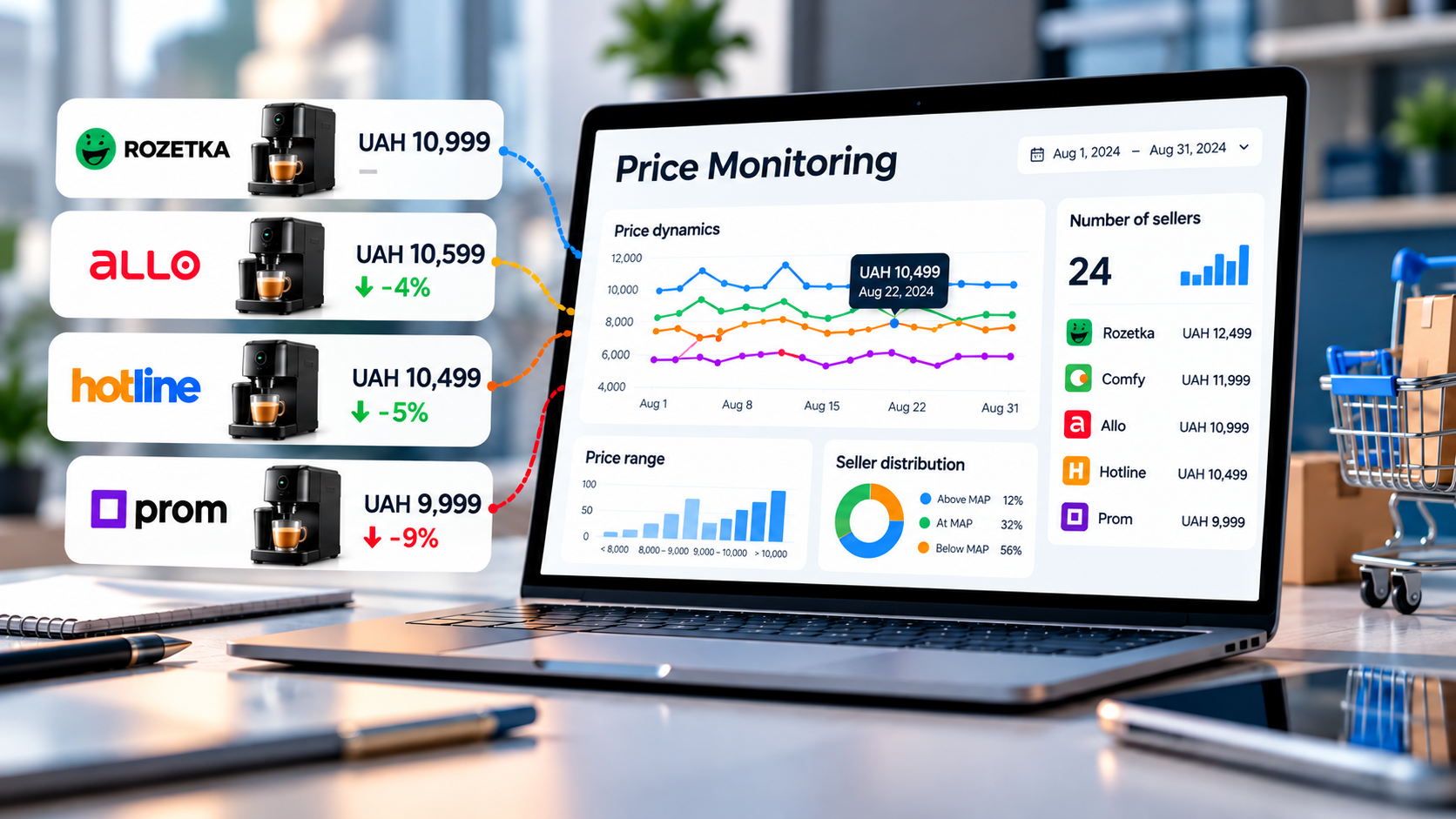
Price monitoring is the systematic tracking and analysis of product prices across online stores, marketplaces, and other online sales channels. It helps businesses identify market changes, compare offers from competitors and sellers, and use up-to-date pricing data to make informed decisions.
Why Businesses Need Price Monitoring
Prices in e-commerce are constantly changing: competitors launch promotions, sellers adjust their offers, and marketplaces create additional price competition. Regular price monitoring helps businesses detect these changes promptly, assess market conditions, and make decisions based on up-to-date data rather than outdated manual price checks.
What Can Be Tracked with Price Monitoring
Systematic price monitoring allows businesses to track not only current product prices but also price changes over time, offers from individual sellers, competitor prices, compliance with recommended retail prices (RRP) and minimum advertised prices (MAP), product availability, and promotional offers. This provides a clear view of market pricing trends and helps businesses quickly identify significant price deviations.Системний моніторинг дозволяє відстежувати не лише поточну ціну товару, а й її зміни в часі, пропозиції окремих продавців, ціни конкурентів, дотримання РРЦ і МРЦ, наявність товарів та акційні пропозиції. Це дає можливість бачити цінову ситуацію на ринку в динаміці та швидко виявляти суттєві відхилення.
Main Types of Price Monitoring
Depending on their business needs, companies can monitor competitor prices, track prices set by sellers and dealers, analyze compliance with recommended retail prices (RRP) and minimum advertised prices (MAP), compare offers across marketplaces, and examine price trends within specific product categories. Each of these approaches serves a different purpose, but all rely on the regular collection and analysis of up-to-date pricing data.
How Automated Price Monitoring Works
Automated price monitoring uses specialized systems to regularly collect data from online stores and marketplaces. The system identifies relevant products, records their prices, availability, and other attributes, and then organizes the collected data for comparison and analysis. This enables businesses to monitor large product catalogs and numerous sellers without constantly checking websites manually.
Who Needs Price Monitoring
Price monitoring is used by manufacturers and brands, distributors, online retailers, and other e-commerce businesses. It helps manufacturers track seller prices and monitor pricing across their dealer networks, enables distributors to analyze market conditions and price changes, and allows online retailers to compare their offers with competitors and adjust their pricing strategies.
What Data Is Needed for Price Monitoring
For effective price monitoring, it is important to identify the products, sellers, and data sources that need to be tracked. The data typically analyzed includes product names and identifiers, current and promotional prices, product availability, seller information, the date of each price check, and price change history. For manufacturers and brands, additional important metrics may include recommended retail prices (RRP), minimum advertised prices (MAP), and the extent to which actual prices deviate from these benchmarks.
Manual vs. Automated Price Monitoring
Manual price monitoring may be sufficient when only a few products need to be checked across a small number of sellers. However, as the product range and number of data sources grow, this approach becomes increasingly time-consuming, and the collected data quickly becomes outdated. Automated price monitoring enables businesses to regularly collect large volumes of data, maintain a history of price changes, and identify significant price deviations more quickly.
How to Use Price Monitoring Data
Price monitoring data can be used to analyze the competitive landscape, track seller prices, evaluate the effectiveness of pricing strategies, and identify market trends. It is important not just to record individual prices but to analyze how they change over time: which seller changed a price, when the deviation occurred, how significant it was, and how other market participants responded.
Price Monitoring as a Basis for Decision-Making
Price data alone does not provide ready-made answers about what actions a business should take. Its value increases when information is collected over time, compared, and analyzed to identify trends. Regular price monitoring helps businesses understand actual market conditions, identify patterns, and make data-driven pricing decisions rather than relying on isolated observations.