
Price Scraping: How to Collect, Validate and Use Competitor Pricing Data
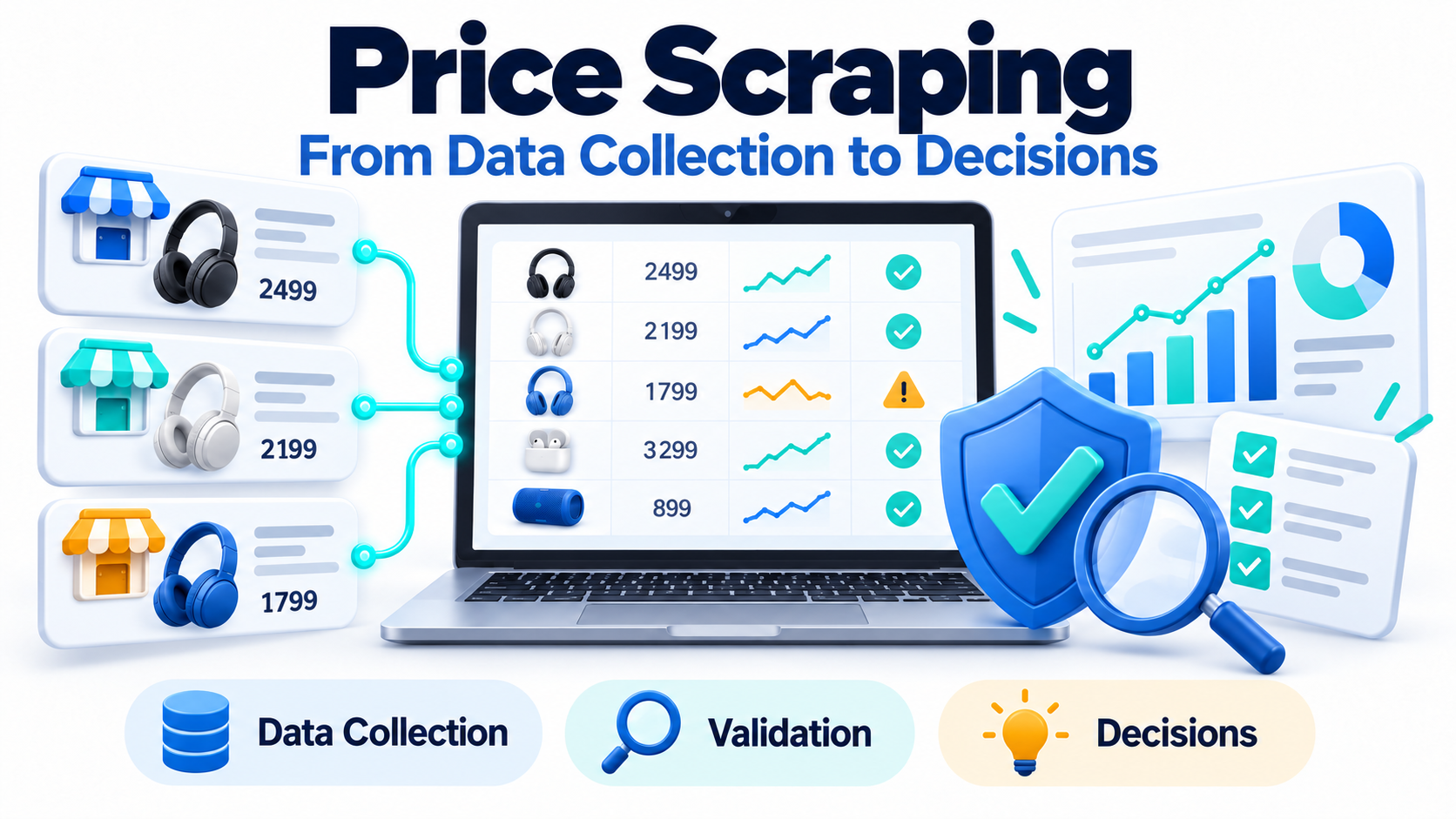
A competitor lowers a price, launches a promotion or runs out of stock. Checking websites manually can reveal these changes, but keeping a consistent record becomes harder as your product range grows.
Price scraping helps collect competitor offers regularly. Its value depends on what happens next: matching the right products, checking purchase conditions and turning reliable observations into decisions.
This guide explains what to collect, how to choose a tool and how to build a practical workflow without treating every lower price as a reason to reduce your own.
What Is Price Scraping?
Price scraping is the automated extraction of pricing information from online product pages. A price scraper collects selected fields and makes them available in a spreadsheet, dashboard or another business system.
Three activities work together:
Scraping collects information from specified sources.
Monitoring repeats collection and records changes over time.
Analysis helps the team interpret those changes and decide what to do.
The business rationale is introduced in this overview of competitor price scraping on Nevsedoma.
A collected price is an observation about an offer at a particular moment. It does not reveal a competitor’s actual sales, profit or reasons for changing that price.
What Data Should You Collect?
A useful pricing record should identify the product, seller, purchase conditions and time of observation.
Start with:
your internal product identifier;
the competitor’s product name and relevant specifications;
the source URL and seller identity;
the current price and currency;
stock availability;
promotional conditions, where available;
the collection timestamp and status.
Shipping costs, dispatch times, pack size, warranty and product condition may also affect the comparison.
For example, a members-only discount differs from a price available to every customer. A refurbished device differs from a new one, even when the model name looks identical.
The importance of this context is discussed in “Competitor Price Scraping: What Data Does an Online Store Really Need?”. Define the fields your team needs before choosing how to collect them.
How to Match Products and Seller Offers
Confirm the Exact Product Variant
Match the characteristics that determine the product: model, capacity, size, pack quantity, configuration and condition.
Manufacturer part numbers and GTINs can help where available, but should be checked against the offer description. Retailers’ internal SKUs are not necessarily shared identifiers.
An incorrectly matched product can produce a technically accurate price that is unsuitable for your comparison.
Keep Seller Identity Separate
On a marketplace, one product page may contain offers from several sellers. Record which seller each price belongs to.
If the default offer changes between checks, the displayed price may change even though neither seller has adjusted its own price.
For seller-level monitoring, use one record per product variant, seller and observation time. Keep the history of the lowest observed price separate from each seller’s history.
Compare Equivalent Purchase Conditions
Decide which offers belong in the main comparison. You may need separate groups for in-stock products, backorders and conditional discounts.
Where delivery affects the comparison, use a consistent scenario, such as one unit delivered to a specified location. If a condition cannot be verified, flag it as unknown.
How to Choose a Price Scraping Tool
Different tools solve different parts of the process. A browser extension may suit a small extraction task. A general-purpose scraper may offer flexibility but require technical maintenance. A specialised monitoring service may combine collection, matching, history and reporting.
A custom solution can support unusual requirements, provided the business has resources to maintain it.
To explore the options, see Joy-Pup’s overview of price scraping tools and Techicy’s comparison of competitor price scrapers. Use these articles to build a shortlist, then verify current capabilities and terms directly.
Test Your Actual Sources
Ask each provider to work with the same sample of products and websites. A successful demonstration on a convenient example does not establish coverage of your sources.
Check whether the tool captures the agreed sellers, variants and fields, and whether it distinguishes missing information from failed collection.
Check the Output and Support Process
Request a sample export. Confirm that your product identifiers, source links, timestamps and collection statuses remain available.
Also clarify who fixes collection after a website changes, how failures are reported and whether historical data can be exported.
Compare the Full Cost
Include setup, source connections, product matching, collection frequency, integrations, maintenance and your team’s review time.
Compare proposals for the same scope. A lower subscription price may leave more manual work with your team.
How to Validate Scraped Prices
Begin with a control sample covering different sources and difficult cases: promotional products, unavailable items, multiple variants and marketplace sellers.
Compare results with the source pages as close to collection time as possible. Otherwise, a genuine price change may look like an extraction error.
Common problems include:
a monthly instalment captured as the full price;
a conditional discount treated as universally available;
a different product variant matched;
an old price displayed after an unsuccessful refresh;
a missing value converted to zero;
duplicate offers counted more than once.
Keep “out of stock,” “price not found” and “page not checked” as separate statuses.
Measure coverage and accuracy separately. A file may contain correct prices for only part of the agreed offer list. Record both how much was collected and what the checked sample reveals about correctness.
What Can You Automate?
Once collection is reliable, automation can help with recurring tasks:
updating competitor price reports;
flagging significant changes;
tracking availability and promotions;
maintaining historical observations;
preparing inputs for pricing reviews.
These applications are explored in “5 Tasks a Web Price Crawler Solves for Online Stores”.
Assign a responsible person and an expected action to each report or alert. Set collection frequency according to how quickly the category changes and how often the team can respond.
Automatic price changes require additional controls: margin limits, data freshness checks and a process for handling suspicious values. Establish dependable collection and review before connecting the data to automated actions.
How to Use the Data for Pricing Decisions
A competitor price gap is a reason to investigate.
If your offer is more expensive, check availability, delivery, warranty and service differences. If your price is substantially lower than comparable offers, assess whether an adjustment fits your costs, stock position and commercial goals.
After making a change, track your own orders, conversion, margin and contribution after relevant costs. Higher revenue alone does not establish a better financial outcome.
Avoid interpreting a competitor’s missing offer as proof that the product sold out successfully. Public price and availability observations support hypotheses; they do not confirm demand.
Start With a Controlled Pilot
Choose one category, a defined set of competitors and a clear reporting task. Agree on the required fields, collection schedule, comparison rules and acceptance criteria.
Run several collection cycles, review errors and confirm that someone can use the report to make a specific decision. Agree on the permitted access method and source requirements before regular collection begins.
Expand once the team can explain where each price came from, when it was checked and which conditions apply. That creates a workable foundation for using competitor pricing data consistently.