
Automating the Fight Against Price Dumping: How to Use Price Monitoring and Analytics
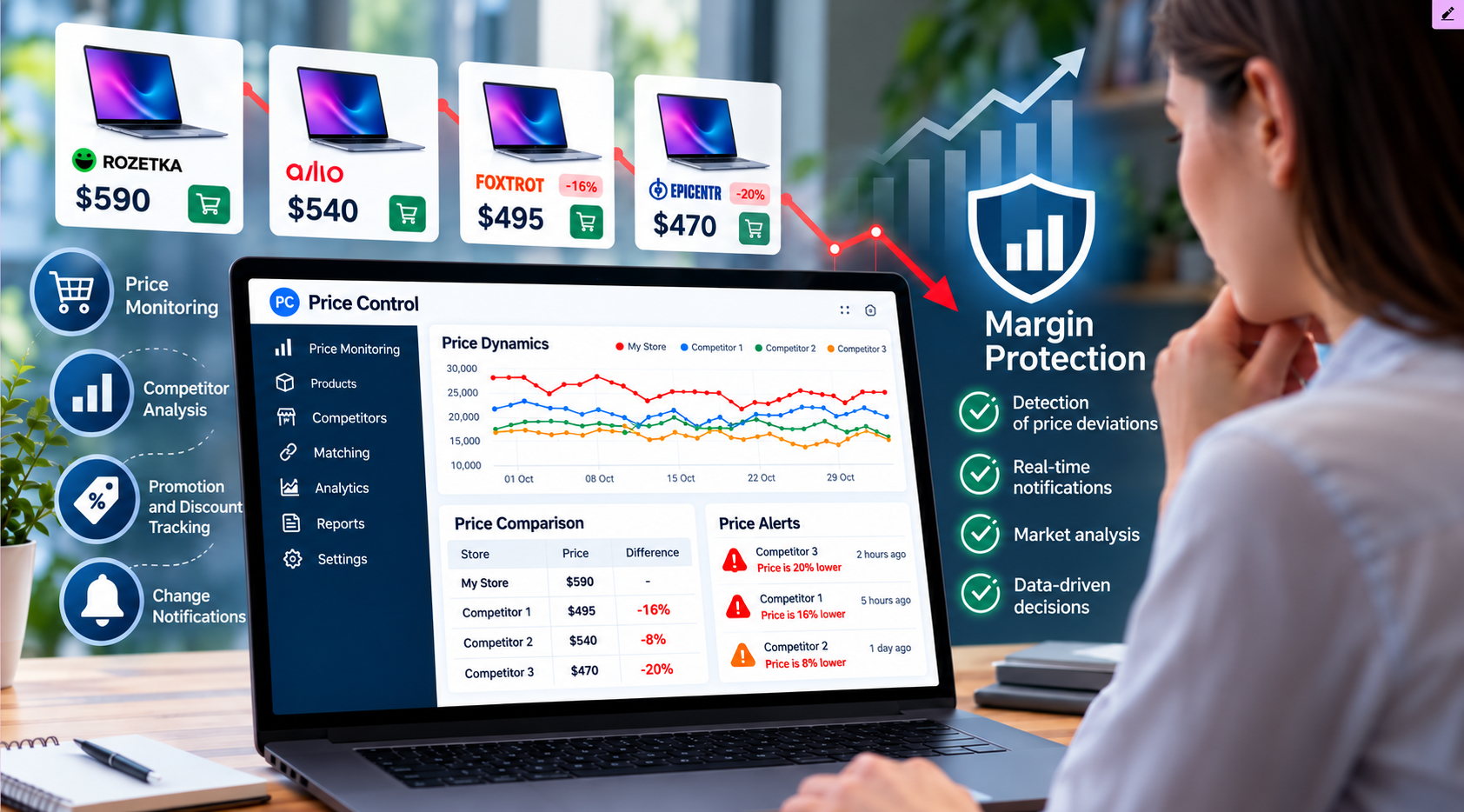
Price dumping in e-commerce often develops faster than businesses can respond. A single retailer lowers its prices, competitors begin adjusting their offers, and within a short period, the entire market may face increased price pressure.
For online retailers, this can lead to shrinking profit margins and price wars. For manufacturers and distributors, significant price differences across sales channels can create additional challenges, including inconsistent brand positioning and tensions among retail partners.
Manual price checks are rarely sufficient to keep up with these changes, especially when a company needs to track thousands of products across multiple websites and marketplaces.
Automated competitor price monitoring offers a more systematic approach. It enables businesses to collect pricing data regularly, identify significant deviations, analyse historical trends, and respond to market changes based on reliable information rather than assumptions.
In this article, we explain how to automate price dumping detection, use competitive pricing analytics to protect profit margins, and implement a price monitoring system that supports informed business decisions.
Why Manual Price Monitoring Fails to Protect Businesses Against Price Dumping
Manual competitor price monitoring may seem like a simple and inexpensive solution. Employees visit competitors’ websites, compare product prices, and record the results in spreadsheets.
However, as product catalogues expand and competition intensifies, this approach becomes increasingly difficult to manage.
The main limitation of manual monitoring is that businesses often discover important price changes too late to respond effectively.
Price changes happen faster than manual checks
In highly competitive e-commerce markets, retailers may adjust prices several times a day.
A competitor can launch a promotion in the morning, reduce prices again in the afternoon, and restore the original prices by the following day.
If a company checks competitors’ prices only once or twice a week, many of these changes will remain unnoticed.
As a result, commercial decisions may be based on outdated information rather than actual market conditions.
Large product catalogues make manual monitoring inefficient
Consider an online retailer selling 3,000 products and tracking five competitors.
A comprehensive comparison would require up to 15,000 product-price checks during a single monitoring cycle, assuming each competitor offers every product.
Repeating this process regularly would require substantial employee time.
Moreover, the workload increases as the company adds new products, competitors, and marketplaces.
Automated price monitoring addresses this scalability problem by collecting information from multiple sources without requiring employees to check each product manually.
Human errors reduce data accuracy
Manual comparisons can produce inaccurate results when employees confuse product models, overlook differences in specifications, or record incorrect prices.
For example, two smartphones may look identical but have different storage capacities. Comparing their prices without checking the specifications could create a misleading impression of aggressive discounting.
Incorrect product matching can lead to unnecessary price reductions and poor commercial decisions.
Spreadsheets do not provide a complete pricing history
Another limitation is the difficulty of maintaining consistent historical records.
Employees may overwrite previous prices, use different spreadsheet formats, or fail to record when a particular change occurred.
Without reliable historical data, it becomes difficult to determine whether a low price represents a temporary promotion, a recurring discount, or a sustained market trend.
Price history is particularly important when analysing how competitors respond to one another.
Manual monitoring increases operational costs
Even when a company does not pay for specialised software, manual monitoring is not free.
Employees spend working hours collecting information instead of analysing results, developing pricing strategies, or improving customer service.
As the number of monitored products increases, these hidden operational costs become more significant.
Why automation provides a better foundation
Automated monitoring systems regularly collect competitor pricing data, match identical products, identify deviations, and preserve historical information.
Instead of spending most of their time gathering prices, employees can focus on interpreting changes and making informed decisions.
However, automation does not eliminate the need for human judgement. Significant price deviations still require verification, especially when promotions, product availability, or unusual sales conditions are involved.
The key advantage of automation is not simply faster data collection. It is the ability to build a consistent, scalable, and more reliable process for competitive pricing analysis.
How Automated Price Monitoring Detects Potential Price Dumping
Automated price monitoring helps businesses identify significant price deviations without manually checking hundreds of competitor websites. Instead of relying on occasional observations, companies receive regularly updated information about market prices, product availability, and pricing trends.
The process typically consists of five stages.
1. Collecting competitor pricing data
A price monitoring system regularly checks selected online stores and marketplaces, collecting information about product prices, availability, discounts, and promotional offers.
Depending on the market and business requirements, monitoring can be performed several times a day.
This allows companies to identify pricing changes much sooner than they could through periodic manual checks.
2. Matching identical products
Accurate price comparisons require matching the same products across different websites.
For example, a retailer selling a particular laptop model should compare its price with offers for the identical configuration, rather than similar devices with different specifications.
Automated monitoring systems use product identifiers, names, specifications, and other available attributes to establish these matches.
Manual verification may still be necessary for complex catalogues or inconsistent product descriptions.
3. Identifying significant price deviations
Once products have been matched, the system compares prices and identifies offers that differ significantly from the selected benchmark.
For an online retailer, this benchmark may be its own selling price or a relevant market reference.
For a manufacturer, the recommended retail price (RRP) may serve as an analytical reference.
For example, if a product normally sells for $200 and a competitor offers it for $165, the system can flag the 17.5% difference for further analysis.
However, a low price alone does not establish that a seller is dumping products below cost or acting unlawfully.
4. Sending alerts about important changes
Instead of requiring employees to review thousands of price records, automated systems can highlight changes that meet predefined criteria.
These may include substantial price reductions, repeated deviations, or changes affecting strategically important products.
Alerts help commercial teams prioritise the situations that require attention.
The effectiveness of notifications depends on appropriate thresholds and the quality of the underlying data.
5. Analysing price history and market trends
The final stage involves analysing how prices change over time.
Historical data helps businesses identify recurring discounts, compare competitors’ pricing behaviour, and assess whether a particular deviation is temporary or sustained.
It also provides a stronger foundation for decisions about pricing, product positioning, and profitability.
From automated detection to informed decisions
Automated price monitoring does not mean that every detected price reduction requires an immediate response.
Before changing prices, businesses should consider product availability, promotional conditions, customer demand, and their own profit margins.
A more detailed discussion of automated approaches is available in the article “How to Automatically Combat Competitors’ Price Dumping”.
The primary value of automated monitoring is the ability to detect relevant pricing changes early, verify their significance, and support decisions with consistent market data.
How to Distinguish Price Dumping from Regular Discounts and Price Fluctuations
Not every significant price reduction should be classified as price dumping. Online retailers frequently adjust prices because of seasonal promotions, inventory clearance, changes in supplier costs, or shifts in customer demand.
For businesses monitoring competitors, the challenge is to distinguish ordinary market fluctuations from pricing behaviour that may create sustained competitive pressure.
A reliable assessment requires more than comparing two prices at a single point in time.
1. Analyse how long the reduced price remains active
The duration of a price reduction is one of the first factors to examine.
A retailer may offer a substantial discount for several hours during a flash sale. Another seller may maintain a significantly lower price for several weeks.
These situations have different implications for competitors.
Short-term promotions do not necessarily justify changes to a company’s pricing strategy. Sustained reductions, however, may indicate a longer-term shift in market pricing.
Automated price monitoring makes it possible to track how long deviations persist and whether they occur repeatedly.
2. Measure the size of the price deviation
The difference between a competitor’s price and the selected benchmark helps determine which offers deserve closer attention.
For example, consider a product with a typical market price of $250.
One retailer offers it for $245, while another lists the identical product for $195.
The first difference may reflect normal competitive pricing. The second represents a 22% reduction from the $250 benchmark and warrants further investigation.
However, the percentage difference alone cannot establish whether the seller is pricing below cost.
Businesses should use deviation thresholds to prioritise analysis rather than automatically label every large discount as dumping.
3. Check product availability and promotional conditions
An unusually low advertised price may not represent a standard offer available to every customer.
The product could be temporarily out of stock, offered only to loyalty programme members, or discounted as part of a limited promotion.
Additional conditions may include minimum order quantities, bundled purchases, or restrictions on delivery.
Before responding to a competitor’s price, companies should verify:
Whether the product is actually available for purchase.
Whether the offer applies to the identical product and configuration.
Whether the price includes mandatory charges.
Whether the discount is temporary or part of regular pricing.
Whether special purchase conditions apply.
These checks help prevent misleading comparisons.
4. Examine how other competitors respond
A price reduction becomes more significant when other market participants begin changing their offers.
Suppose one retailer lowers the price of a product by 15%.
If competing stores maintain their prices, the change may remain an isolated promotion.
If several sellers subsequently introduce similar reductions, the market may be experiencing broader pricing pressure.
Historical monitoring data helps identify these patterns and compare the timing of observed changes.
However, similar price movements do not necessarily prove that competitors are reacting directly to one another.
5. Look for recurring pricing patterns
Some online retailers repeatedly offer substantial discounts on particular products or categories.
These reductions may occur during weekends, promotional campaigns, or periods of increased competition.
By analysing historical data, businesses can identify recurring patterns and distinguish predictable promotional activity from unusual price movements.
This information can support better inventory planning, promotional scheduling, and pricing decisions.
6. Verify alerts before taking action
Automated monitoring systems can detect significant price deviations, but not every alert requires an immediate commercial response.
Before adjusting prices, managers should verify the underlying data and consider the potential effect on profitability.
For manufacturers and distributors, deviations from recommended retail prices should also be evaluated carefully. An RRP is a reference point, not proof that an independent retailer has engaged in unlawful conduct.
A related discussion of automated approaches can be found in “How to Combat Competitors’ Price Dumping Automatically”.
Why accurate classification matters
Misinterpreting temporary discounts as sustained price dumping can encourage unnecessary price cuts and reduce profit margins.
Conversely, ignoring persistent market changes may weaken a retailer’s competitive position.
The most effective approach combines automated detection, historical price analysis, and verification of actual selling conditions.
This allows businesses to respond to meaningful pricing developments without becoming involved in avoidable price wars.
Price History Analysis: How to Identify the Sources of Price Deviations
Detecting a competitor’s low price is only the first step. To make an informed decision, businesses need to understand when the price deviation appeared, how long it lasted, and how other sellers responded.
This is why historical pricing data is one of the most valuable components of automated competitor price monitoring.
Price history analysis helps businesses move beyond isolated price comparisons and understand how competitive pricing develops over time.
How to identify which seller lowered prices first
Consider five online retailers selling the same household appliance.
At the beginning of the week, their prices are relatively similar. One retailer then reduces its price by 12%, and several days later, other sellers introduce comparable discounts.
If a monitoring system regularly records prices, businesses can reconstruct the sequence of observed changes.
The analysis can reveal:
When the first significant price reduction was detected.
Which retailer displayed the lower price before the others.
How quickly competitors introduced similar changes.
How the overall market price level developed.
However, it is important to distinguish the first seller identified by the monitoring system from the actual initiator of a price reduction.
Price changes may occur between monitoring cycles. Several retailers may also respond independently to the same supplier promotion, seasonal trend, or market conditions.
Historical data therefore provides evidence of observed pricing patterns, not definitive proof of which seller initiated a market-wide price reduction.
Why the duration of price deviations matters
A temporary discount does not necessarily have the same commercial impact as a sustained price reduction.
For example, an online store may offer a discounted product for a few hours before returning to its regular price.
Another retailer may maintain a substantially lower price for several weeks.
The second situation may create greater pressure on competitors and influence customer expectations.
Price history allows businesses to measure the duration of deviations, identify repeated reductions, and evaluate whether lower prices are becoming a persistent market trend.
This helps commercial teams decide whether a pricing change requires immediate attention or continued observation.
How to detect recurring pricing patterns
Some retailers use predictable promotional strategies.
They may reduce prices on weekends, launch short-term discounts during major shopping events, or regularly adjust prices for popular products.
Without historical records, these changes can appear random.
Automated price monitoring makes it easier to identify:
Repeated discounts in specific product categories.
Regular promotional activity by particular retailers.
Price reductions before seasonal sales.
Price increases after promotional campaigns.
Persistent differences between online stores and marketplaces.
Recognising these patterns helps businesses anticipate periods of stronger price competition and prepare appropriate commercial responses.
How to analyse competitors’ reactions
Historical pricing data also helps businesses compare the behaviour of multiple sellers.
Suppose one retailer introduces a significant discount, while most competitors maintain their existing prices.
In this situation, an immediate price reduction may be unnecessary.
However, if several competing retailers subsequently lower their prices, the company may need to reassess its pricing strategy.
Before responding, it should consider purchasing costs, customer demand, inventory levels, and expected profit margins.
It is also useful to compare price changes with product availability and promotional conditions.
For example, a substantial discount may apply only to a limited quantity of remaining stock rather than reflect a permanent pricing strategy.
How businesses can use historical pricing data
For online retailers, price history supports decisions about product pricing, promotional activities, assortment management, and competitive positioning.
Instead of automatically matching a lower competitor price, a business may strengthen its offer through faster delivery, additional services, or better warranty conditions.
For manufacturers and distributors, historical data helps assess pricing developments across sales channels, identify persistent deviations from recommended retail prices, and prepare analytical reports.
However, deviations from an RRP do not automatically indicate unlawful price dumping or justify restrictions on independent retailers’ resale prices.
What makes price history analysis reliable?
Reliable analysis depends on consistent data collection, accurate product matching, and proper storage of monitoring results.
Businesses should also consider product availability, discounts, promotional terms, and differences in product specifications.
The frequency of monitoring matters as well. More frequent checks can reduce gaps in the observed timeline, although they cannot guarantee that every market change will be captured.
The more complete and consistent the historical data, the better businesses can understand competitive pricing behaviour and evaluate its commercial implications.
Ultimately, price history transforms automated monitoring from a simple price comparison tool into a source of actionable competitive intelligence.
It helps companies identify recurring patterns, assess market developments, and make pricing decisions without unnecessarily entering price wars.
How to Protect Profit Margins with Pricing Analytics
When competitors begin lowering their prices, online retailers may feel pressured to follow their lead immediately. Offering a lower price can appear to be the easiest way to retain customers and maintain sales.
However, this approach can significantly reduce profitability, even when sales volumes remain unchanged.
The primary goal of pricing analytics is to help businesses remain competitive without sacrificing profit margins on every sale.
Why lowering prices can be more expensive than losing some sales
Consider an online retailer selling a product for $200.
The purchase cost is $140, while variable expenses associated with processing, fulfilling, and delivering the order amount to $25.
The contribution margin per unit is:
$200 − $140 − $25 = $35.
Now suppose a competitor reduces its price and the retailer decides to match an offer of $175.
The new contribution margin becomes:
$175 − $140 − $25 = $10.
A 12.5% reduction in the selling price has therefore reduced the contribution margin per unit by approximately 71%.
To generate the same $350 in total contribution margin, the retailer would need to sell 35 units instead of 10, assuming the same unit costs.
This simplified example demonstrates why participating in a price war may be financially unsustainable.
How to identify products most vulnerable to price competition
Not every product is equally sensitive to price reductions.
Some products have sufficient margins to accommodate occasional discounts. Others may become unprofitable after even a small price adjustment.
When evaluating pricing risks, businesses should consider:
Product acquisition or manufacturing costs.
Variable selling and fulfilment expenses.
Current contribution margins.
Sales volume and demand trends.
Availability of comparable competitor offers.
The strategic importance of individual products.
For example, a popular product with a narrow margin may require stricter pricing limits than an accessory with a relatively high margin.
How competitor price monitoring helps protect profitability
Automated price monitoring allows businesses to evaluate competitors’ offers before changing their own prices.
If most retailers maintain relatively stable prices, a discount from one competitor does not necessarily justify an immediate response.
Instead, the company can verify whether the product is in stock, examine promotional restrictions, and determine how long the reduced price remains available.
This approach helps prevent unnecessary discounts and supports more informed commercial decisions.
Additional approaches to protecting profitability are discussed in the article “Combating Price Dumping: Seven Ways to Protect Profits”.
When non-price advantages are a better strategy
Customers do not make purchasing decisions based on price alone.
Delivery speed, product availability, warranty conditions, customer support, payment options, and seller reputation can all influence their choices.
Instead of immediately matching a competitor’s lower price, an online retailer may strengthen its offer through:
Faster or more convenient delivery.
Extended warranty coverage.
Better after-sales support.
Flexible payment or return options.
Additional services or product bundles.
The costs of these benefits should also be included when assessing profitability.
How dynamic pricing can help maintain healthy margins
Dynamic pricing allows online retailers to adjust product prices according to predefined rules and changing market conditions.
However, effective pricing automation should include financial safeguards.
For example, pricing rules can take into account minimum acceptable selling prices, target contribution margins, and the importance of particular product categories.
If a competitor’s price falls below the retailer’s economically justified threshold, the system should not automatically match it.
This allows businesses to remain responsive to market changes while avoiding unprofitable sales.
Which financial indicators should businesses monitor?
Sales volume alone is not enough to evaluate pricing performance.
Companies should also track:
Total contribution margin.
Contribution margin per unit.
Average order value.
Number of orders.
Share of sales generating a positive contribution margin.
The effect of discounts on overall profitability.
For example, a 20% increase in sales does not necessarily improve financial performance if the contribution margin per order falls by half.
Competitive pricing data should therefore be analysed alongside internal sales and cost information.
The key takeaway is that pricing analytics helps businesses choose financially sustainable strategies instead of automatically following every competitor discount.
Effective responses to price dumping are not about always offering the lowest price. They are about maintaining competitiveness while protecting the company’s long-term profitability.
How to Automate Price Monitoring with Price Control
Moving from manual price checks to automated competitor price monitoring does not necessarily require a complete restructuring of business processes. The key is to define clear objectives, select relevant products and competitors, establish regular data collection, and create a consistent process for analysing the results.
Specialised platforms such as Price Control can support these activities by providing price monitoring and analytics for online retailers, manufacturers, brands, and distributors.
The following seven steps outline a practical approach to implementation.
Step 1. Define your price monitoring objectives
Before implementing a monitoring system, businesses should identify the problems they want to solve.
For online retailers, common objectives include tracking competitor prices, identifying significant market changes, and protecting profit margins.
Manufacturers and distributors may focus on analysing prices across distribution channels, discovering additional sellers, and monitoring deviations from recommended retail prices (RRP).
These objectives determine which products to monitor, which data sources to include, and how frequently information should be updated.
Step 2. Select products and competitors
The next step is to prepare a product catalogue and identify relevant competitor websites and marketplaces.
It is usually more effective to begin with priority products, such as high-demand items, strategically important categories, or products facing intense price competition.
Accurate comparisons require matching identical products across different websites.
Price Control supports automated, manual, and combined product matching approaches.
The quality of these matches directly affects the reliability of pricing analytics.
Step 3. Configure automated price collection
Once the catalogue and competitors have been selected, businesses need to establish a suitable monitoring frequency.
Price Control supports monitoring from 1 to 24 times per day, depending on the selected configuration and service conditions.
Highly competitive product categories may require more frequent updates, while daily monitoring may be sufficient for products with relatively stable prices.
Depending on the monitoring configuration, businesses can also collect information about product availability, promotions, discounts, and other relevant offer characteristics.
Step 4. Set up price deviation alerts
Reviewing every collected price manually would undermine many of the benefits of automation.
Instead, businesses should define which changes require attention.
For example, an online retailer may want to receive alerts when a competitor’s price falls more than a specified percentage below its own selling price.
Manufacturers may use recommended retail prices as analytical benchmarks to identify significant deviations across sales channels.
Price Control helps organise pricing information and supports notifications about relevant changes.
A practical overview of this approach is available in the article “How to Combat Price Dumping Automatically with Price Control”.
However, alerts should be treated as signals requiring verification rather than automatic evidence of unfair or unlawful pricing.
Step 5. Analyse price history and generate reports
A single price deviation rarely provides enough information to understand the competitive situation.
Historical pricing data helps businesses examine how offers change over time and whether particular patterns are temporary or persistent.
Useful insights include:
Products that frequently experience substantial discounts.
Sellers associated with repeated price deviations.
Changes in average market price levels.
The duration of significant price differences.
Competitors’ observed responses to market developments.
These insights help sales managers, marketing teams, and commercial directors make decisions based on consistent market information.
Step 6. Apply pricing analytics to commercial decisions
For online retailers, the next stage may involve implementing dynamic pricing rules.
Prices can be adjusted according to competitor offers, target contribution margins, and predefined financial limits.
For example, a retailer may choose to remain competitive within a particular price range without allowing automated adjustments to reduce its contribution margin below an acceptable threshold.
For manufacturers and distributors, pricing analytics primarily supports market visibility, commercial planning, and evaluation of sales channel performance.
Monitoring deviations from recommended retail prices must not be used to unlawfully impose fixed or minimum resale prices on independent retailers.
Step 7. Evaluate results and expand monitoring coverage
After implementation, businesses should measure whether the monitoring system achieves its objectives.
Relevant indicators may include:
Speed of detecting significant price deviations.
Coverage of priority products and competitors.
Accuracy of product matching.
Time saved on manual price collection.
Quality and usefulness of alerts.
Changes in pricing performance and profitability.
A practical starting point is to launch a pilot project covering a limited number of products and competitors.
Once the data quality, notification rules, and reporting processes have been validated, monitoring coverage can be expanded gradually.
Building a sustainable price monitoring process
Price Control can provide the technological foundation for systematic competitor price monitoring, combining regular data collection, price deviation analysis, historical records, and support for commercial decision-making.
However, successful automation depends on more than software functionality.
Businesses also need clear monitoring objectives, accurate product data, appropriate pricing rules, and employees who can translate analytical findings into effective commercial actions.
When these elements work together, automated monitoring becomes a practical tool for improving market visibility and supporting sustainable pricing strategies.
Common Mistakes in Automated Price Monitoring
Automated price monitoring can significantly reduce the time required to collect competitor pricing data and improve the consistency of market analysis. However, even sophisticated software cannot deliver reliable results if businesses define the wrong objectives or work with inaccurate information.
Understanding the most common implementation mistakes helps companies build a more effective price monitoring process and avoid unnecessary financial risks.
1. Monitoring every product without setting priorities
Some businesses attempt to monitor their entire product catalogue from the beginning, without considering the commercial importance of individual products.
As a result, employees may receive large volumes of pricing information and struggle to identify which changes require immediate attention.
How to avoid it: Start with high-revenue products, strategically important categories, and items facing intense price competition. Expand monitoring coverage gradually as the process becomes more efficient.
2. Comparing products that are not identical
Incorrect product matching is one of the most significant sources of misleading pricing data.
For example, a monitoring system may compare two laptops with different memory configurations or smartphones with different storage capacities.
These differences can create the false impression that a competitor is offering an unusually large discount.
How to avoid it: Use reliable product identifiers, verify specifications, and regularly review product matches to ensure accurate comparisons.
3. Reacting to every competitor price reduction
Automatically lowering prices whenever a competitor introduces a discount can significantly reduce profit margins.
This is particularly risky when the competitor’s offer is temporary, incorrectly displayed, or unavailable to most customers.
How to avoid it: Establish meaningful deviation thresholds, verify selling conditions, and introduce minimum profitability requirements before making pricing adjustments.
4. Ignoring historical pricing data
A current price does not reveal whether a reduction is temporary, seasonal, or part of a sustained pricing strategy.
Without historical records, businesses cannot reliably assess how long a deviation has existed or whether similar changes have occurred before.
How to avoid it: Analyse price trends across multiple periods, compare competitors’ observed behaviour, and consider the frequency of monitoring updates.
5. Generating too many price alerts
When monitoring systems send notifications about every minor price fluctuation, employees may begin ignoring them.
Important developments can become difficult to identify among large numbers of low-priority messages.
How to avoid it: Configure alerts according to product importance, deviation size, duration, and potential commercial impact. Review notification settings regularly to maintain their usefulness.
6. Failing to connect pricing data with financial performance
Competitor pricing information does not automatically show how a particular market change will affect a company’s profitability.
For example, reducing prices may increase sales volume while lowering total contribution margin.
How to avoid it: Combine monitoring results with internal data on product costs, variable expenses, sales performance, and target margins.
This helps ensure that pricing decisions support financial objectives rather than simply matching competitors.
7. Overlooking competition law requirements
For manufacturers and brands, an additional risk arises when information about recommended retail prices is used incorrectly.
Monitoring deviations from an RRP can support market analysis. However, a retailer’s decision to sell below the recommended price does not automatically constitute unlawful conduct.
Businesses must also avoid using monitoring data to impose unlawful fixed or minimum resale prices on independent retailers.
How to avoid it: Separate market monitoring and analysis from decisions that could restrict independent retailers’ pricing freedom. Ensure that commercial policies comply with applicable competition laws.
How to assess readiness for price monitoring automation
Before implementing a monitoring platform, businesses should confirm that they have identified priority products, established reliable product matching procedures, and defined clear rules for responding to significant price changes.
It is equally important to determine who will review alerts, interpret pricing trends, and make commercial decisions.
Performance indicators should also be established before implementation so that results can be evaluated objectively.
The key takeaway is that successful price monitoring automation depends on accurate data, well-designed business rules, and meaningful financial analysis.
Software helps companies identify pricing developments faster, but effective commercial decisions still require clear objectives and professional judgement.
How to Measure the Effectiveness of Automated Price Monitoring
Implementing automated price monitoring is an investment in better commercial decision-making. However, the number of prices collected or reports generated does not necessarily indicate that a monitoring system is delivering meaningful business value.
To evaluate its effectiveness, companies should establish clear key performance indicators (KPIs) and compare results with their performance before automation.
Speed of detecting price deviations
One of the most important indicators is the time between a significant competitor price change and its detection.
With manual monitoring, employees may discover a price reduction only during their next scheduled check. Automated systems can shorten this interval through regular data collection and alerts.
For example, suppose a company previously detected important pricing changes within 24 hours on average. After automation, the average detection time falls to four hours.
This represents an approximately 83% reduction in detection time.
Actual performance depends on monitoring frequency, data availability, and notification settings.
Coverage of products and competitors
Another important KPI is the proportion of priority products and competitor websites successfully monitored.
Suppose a company identifies 2,000 products for monitoring and regularly receives accurate pricing data for 1,800 of them.
Its effective product coverage is:
1,800 ÷ 2,000 × 100 = 90%.
Businesses should also assess competitor coverage, product matching accuracy, and the percentage of successful monitoring checks.
High coverage is valuable only when the underlying information is sufficiently reliable for commercial decisions.
Reduction in manual workload
Automation can substantially reduce the time employees spend collecting and comparing competitor prices.
For example, a commercial team may previously have spent 60 hours per month on manual price checks.
After implementing an automated system, employees might spend only 12 hours reviewing alerts, verifying data, and analysing results.
The monthly time saving would be:
60 − 12 = 48 hours.
This saving can be converted into a monetary value using the company’s actual labour costs.
However, the calculation should also account for ongoing activities such as maintaining product matches, checking data quality, and adjusting monitoring rules.
Impact on contribution margins
For online retailers, profitability is one of the most meaningful indicators of successful pricing automation.
Monitoring can help businesses avoid unnecessary discounts, identify important market changes, and make more informed pricing decisions.
Relevant financial KPIs include:
Total contribution margin.
Contribution margin per unit.
Percentage of sales with a positive contribution margin.
Number of price adjustments below predefined profitability thresholds.
Sales and margin trends for priority product categories.
However, improved profitability should not automatically be attributed entirely to price monitoring.
Customer demand, seasonality, supplier costs, marketing expenditure, and other factors can also influence financial performance.
Quality and relevance of price alerts
A large number of alerts does not necessarily mean that a monitoring system is effective.
A more useful indicator is the proportion of notifications that identify genuinely important pricing developments.
For example, if a system generates 100 alerts but only 15 require meaningful attention, the company may need to review its notification thresholds and filtering rules.
Businesses should also monitor false alerts caused by incorrect product matching, outdated information, or unusual promotional conditions.
The objective is not to maximise the number of notifications, but to identify commercially relevant changes without overwhelming employees.
Monitoring effectiveness for brands and manufacturers
Manufacturers and distributors may use a different set of performance indicators.
Relevant KPIs include:
Coverage of authorised and other relevant sellers.
Number of newly identified online retailers.
Frequency of significant deviations from recommended retail prices.
Duration of observed pricing deviations.
Time required to prepare pricing reports.
Quality and completeness of market information.
Companies may also track the number of pricing-related enquiries from distribution partners and improvements in the availability of commercial intelligence.
However, reducing deviations from recommended retail prices must not involve unlawful restrictions on independent retailers’ pricing decisions.
How to calculate the economic return from automation
A preliminary financial assessment can compare the cost of monitoring software with measurable savings and improvements in commercial performance.
Consider the following hypothetical monthly results:
Labour cost savings: $400.
Additional contribution margin reasonably attributable to better pricing decisions: $600.
Total monitoring system costs: $300.
The estimated monthly net benefit would be:
$400 + $600 − $300 = $700.
The return on investment can then be calculated as:
ROI = ($700 ÷ $300) × 100 ≈ 233%.
This is a simplified illustrative calculation, not a guaranteed outcome.
A more comprehensive evaluation should include initial implementation costs, ongoing maintenance, and the influence of external market factors.
Why performance measurement matters
Automated price monitoring should be evaluated according to the business outcomes it supports rather than the volume of information it collects.
Faster detection, broader market visibility, reduced manual work, better alert quality, and improved pricing decisions are all important indicators of success.
The ultimate measure of effectiveness is whether automated monitoring helps the company make better commercial decisions while using its resources more efficiently.
By tracking relevant KPIs consistently, businesses can determine whether price monitoring automation delivers measurable value and identify opportunities for further improvement.
Frequently Asked Questions About Automating Price Dumping Detection
What is automated competitor price monitoring?
Automated competitor price monitoring is the process of regularly collecting and analysing product pricing data from online stores and marketplaces using specialised software. Monitoring systems match identical products, detect significant price changes, maintain historical records, and help businesses analyse competitive pricing without relying on continuous manual checks.
How can businesses automatically detect potential price dumping?
Businesses can configure automated monitoring to compare identical products, identify prices that fall below selected benchmarks, and generate alerts when significant deviations occur. Historical pricing data, product availability, and promotional conditions should also be examined. However, a low selling price alone does not prove below-cost dumping or unlawful conduct.
How often should competitor prices be monitored?
The appropriate frequency depends on the product category and how quickly prices change. Highly competitive markets may require several checks per day, while daily updates may be sufficient for products with relatively stable prices. For example, Price Control supports monitoring from 1 to 24 times per day, depending on the selected configuration and service conditions.
Can price dumping detection and response be fully automated?
Many processes can be automated, including price collection, product matching, deviation detection, notifications, and certain dynamic pricing adjustments. However, assessing the reasons behind price reductions, evaluating profitability, and making legally significant commercial decisions still require appropriate oversight. The most effective approach combines automation with professional judgement.
How does competitor price monitoring help protect profit margins?
Competitor price monitoring helps online retailers evaluate market offers before changing their own prices. By combining competitor data with purchase costs, variable expenses, and minimum profitability thresholds, businesses can avoid unnecessary discounts and reduce the risk of unprofitable price competition.
What is the difference between price monitoring and dynamic pricing?
Price monitoring collects and analyses information about competitors’ offers and market trends. Dynamic pricing uses this information, together with other business data, to adjust a company’s own selling prices according to predefined rules. Price monitoring provides the analytical foundation, while dynamic pricing supports the execution of pricing strategies.
Can manufacturers use automated monitoring to track recommended retail prices?
Yes. Manufacturers and distributors can use automated monitoring to identify deviations from recommended retail prices (RRP), analyse historical trends, and prepare reports on pricing across distribution channels. However, recommended prices must remain genuinely non-binding where required by applicable competition law. Monitoring does not authorise manufacturers to impose unlawful fixed or minimum resale prices on independent retailers.
Conclusion: How Automation Helps Businesses Respond to Price Dumping
Price competition in e-commerce requires businesses to respond quickly while understanding the reasons behind market changes. Attempting to combat price dumping simply by lowering prices can lead to shrinking profit margins and prolonged price wars.
Automated competitor price monitoring helps companies move from occasional manual checks to a systematic, data-driven approach to competitive pricing analysis.
Regular data collection, accurate product matching, historical price tracking, and timely alerts make it easier to identify significant pricing deviations and assess their potential business impact.
For online retailers, automation supports more informed pricing decisions, helps protect contribution margins, and creates opportunities to compete through service quality, delivery conditions, and other non-price advantages.
For manufacturers and distributors, automated monitoring improves market transparency, provides insights into seller pricing behaviour, and helps analyse deviations from recommended retail prices while respecting applicable competition laws.
However, automated monitoring does not eliminate price dumping by itself. Its primary value lies in providing reliable information that enables businesses to make timely, financially sustainable decisions.
Specialised platforms such as Price Control can help combine competitor price collection, deviation analysis, historical pricing data, and reporting within a consistent monitoring process.
Businesses can begin with priority products and key competitors, then gradually expand monitoring coverage while measuring results against clearly defined KPIs.
In the long term, sustainable competitive advantage does not necessarily belong to companies offering the lowest prices.
It belongs to businesses that can balance competitive pricing, healthy profit margins, and reliable market intelligence.
By integrating automated price monitoring into their commercial processes, companies can respond to market developments more effectively without becoming trapped in unnecessary price wars.