
How to Monitor Competitor Prices Online
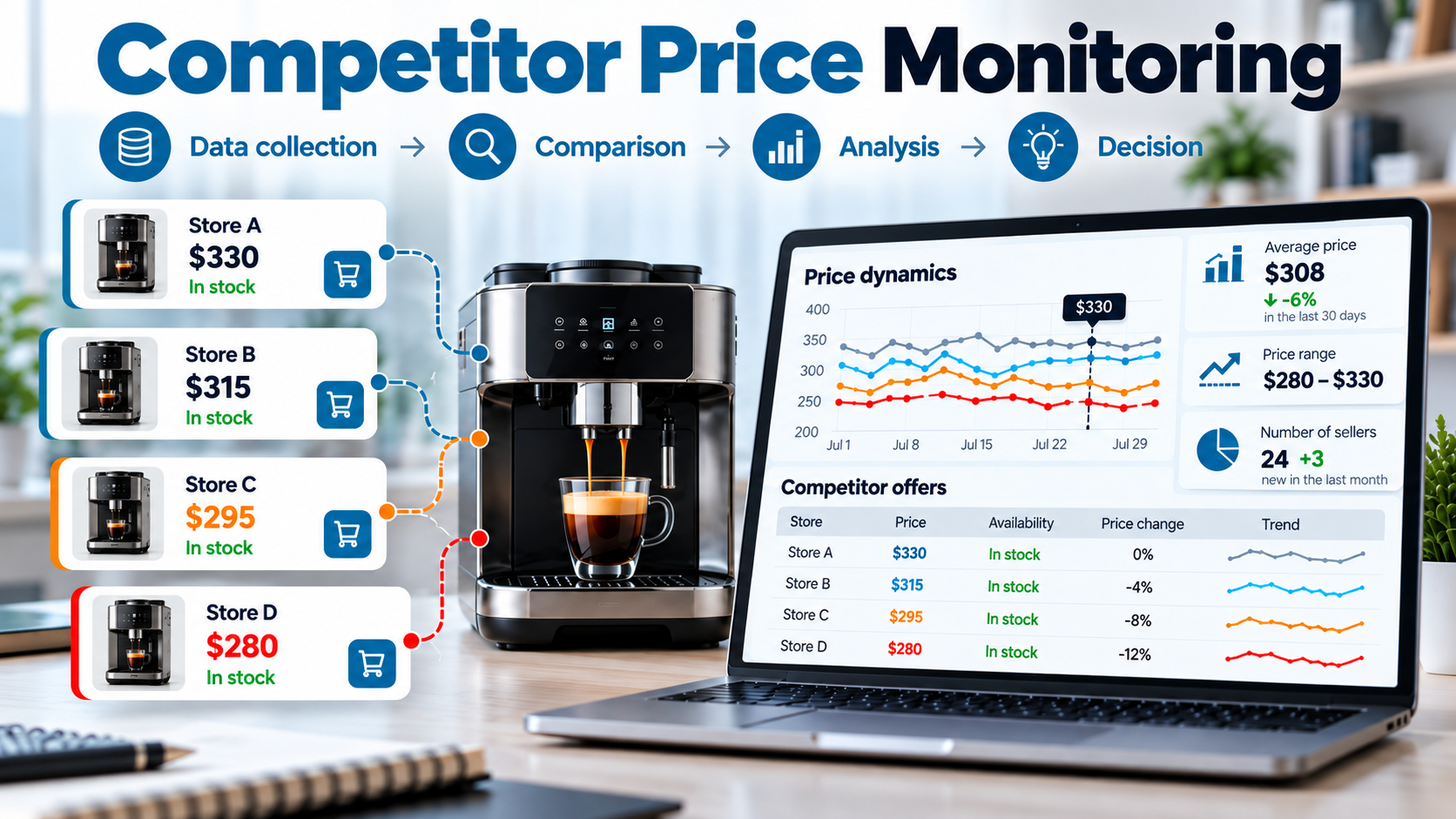
Competitor price monitoring helps businesses understand the prices at which similar products are sold by other online retailers and marketplaces. Regular price tracking allows companies to identify market changes, assess their own competitive pricing position, and respond promptly to competitors’ actions.
However, simply comparing a few prices is not enough. To make the collected data useful for decision-making, businesses need to identify relevant competitors, match identical products, account for promotions and product availability, and analyze price changes over time.
What Is Competitor Price Monitoring?
Competitor price monitoring is the regular collection and analysis of pricing data for identical or comparable products offered by different sellers. Its purpose is not simply to find the lowest price, but to understand the overall market situation, assess the competitiveness of a company’s own offers, and identify significant changes in a timely manner.
Effective competitor price monitoring requires tracking more than just product prices. Product availability, promotional offers, seller information, sales conditions, and the date when the data was collected are also important. Regularly tracking these factors transforms a one-time price comparison into a systematic analysis of the competitive landscape.
What Data Should You Track?
When monitoring competitor prices, it is important to track several categories of data that together provide a more complete picture of the competitive landscape:
- Product price. Record the current price and, whenever possible, the promotional price. To analyze price trends, it is important to retain historical price data.
- Seller. The same product may be offered by dozens of online stores, so it is essential to identify which seller is responsible for each price offer.
- Product availability. A price without information about product availability can be misleading. An offer for a product that is actually out of stock may not represent a meaningful competitive offer.
- Product range and specifications. Before comparing prices, make sure that the offers refer to the same product, model, or configuration.
- Date and time of monitoring. Prices in e-commerce can change throughout the day, so it is important to know exactly when the data was collected.
How to Monitor Competitor Prices
Effective competitor price monitoring involves several consecutive steps. The goal is not simply to collect as many price offers as possible, but to establish a system that allows businesses to regularly update, compare, and use pricing data to make informed decisions.
Identify Your Competitors
First, identify which sellers should be included in your monitoring process. These may include direct competitors, major online retailers, marketplaces, or sellers that regularly influence pricing levels within a specific product category. At the initial stage, it is best to create a clearly defined list of sources and expand it as needed.
Create a List of Products for Comparison
To compare prices accurately, create a list of specific products and ensure that offers from different sellers refer to identical models, configurations, and specifications. If your product catalog contains a large number of items, it is advisable to start with the most important ones: best-selling products, high-margin items, or products facing particularly intense price competition.
Collect Prices and Product Availability Data
Data should be collected regularly and according to consistent rules to ensure accurate comparisons. For each offer, it is important to record the price, product availability, seller, and the date and time of the check. When monitoring a large number of products and websites, manual data collection quickly becomes time-consuming. Therefore, automated data collection is recommended for systematic competitor price monitoring.
Analyze Price Changes Over Time
It is important to evaluate not only the current price but also how it has changed over a specific period. Historical pricing data helps identify recurring price increases and decreases, short-term promotions, and more persistent market trends. This makes it easier to distinguish a one-time price change from a competitor’s systematic pricing strategy. Accurate and up-to-date pricing data is also important for shopping platforms: Google recommends keeping product prices and availability information up to date.
Manual vs. Automated Price Monitoring
Manual price monitoring can be effective when only a small number of products and sellers need to be checked. However, as the product range expands, the number of required checks increases rapidly, making it difficult to keep manually collected data up to date.
Automated price monitoring enables businesses to regularly collect data from a large number of sources, maintain a history of price changes, and identify pricing deviations more quickly. This is particularly important for companies managing extensive product catalogs or monitoring a large number of competitors.
How to Compare Competitor Prices Accurately
Prices should be compared for identical products under comparable sales conditions. It is important to consider the model, configuration, specifications, product availability, and offer type. Promotional prices should also be distinguished from regular prices to prevent temporary discounts from distorting the overall picture.
Rather than focusing solely on the lowest-priced offer, it is much more useful to analyze the full price range, average market prices, and the position of your own offer relative to key competitors.
Common Mistakes in Competitor Price Monitoring
The most common mistake is comparing prices without verifying that the offers actually refer to identical products. Results can also be distorted by promotional offers, different delivery conditions, out-of-stock products, or outdated data.
Another common mistake is relying on prices recorded at a single point in time. A one-time observation does not reveal whether a competitor’s price is consistent or part of a short-term promotion. To make informed pricing decisions, it is much more useful to maintain historical pricing data and analyze price changes over time.
How to Use Competitor Pricing Data in Your Pricing Strategy
Competitor pricing data should be used as one of the factors when setting your own prices, rather than as an automatic instruction to change them. It is important to consider product costs, profit margins, demand, product positioning, and your company’s business objectives.
Price monitoring helps identify when your prices differ significantly from market levels and require further analysis. As a result, businesses can make informed pricing decisions based on up-to-date market data rather than isolated observations.
How Often Should You Monitor Competitor Prices?
The frequency of competitor price monitoring depends on the product category, how quickly prices change, and the level of competition. For relatively stable product categories, daily checks may be sufficient. However, in highly dynamic categories with frequent promotions and price fluctuations, it is advisable to collect pricing data much more frequently.
It is important to maintain a consistent monitoring schedule to ensure that results can be compared over time. Automated price monitoring allows businesses to set the required data collection frequency without constantly checking websites manually.
Conclusion
Competitor price monitoring helps businesses understand the current market situation, track changes, and make more informed pricing decisions. The greatest value comes not from one-time price comparisons, but from regular data collection, maintaining historical pricing records, and analyzing price trends over time.
For a small number of products, manual price monitoring may be sufficient. However, as the product range expands and the number of competitors increases, automation helps keep pricing data up to date and significantly reduces the amount of routine manual work.