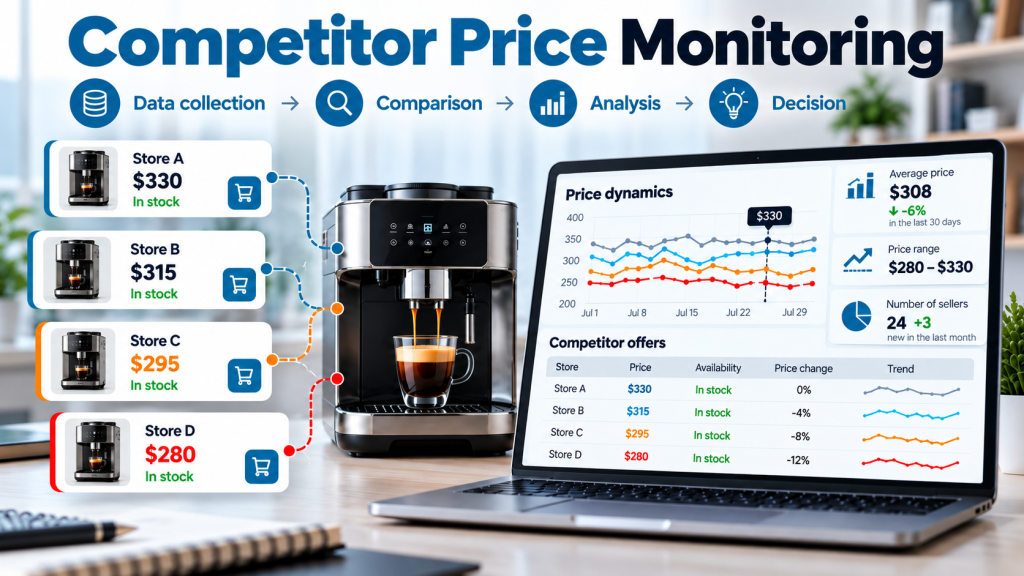
Competitor Price Monitoring: From Tracking Offers to Pricing Decisions
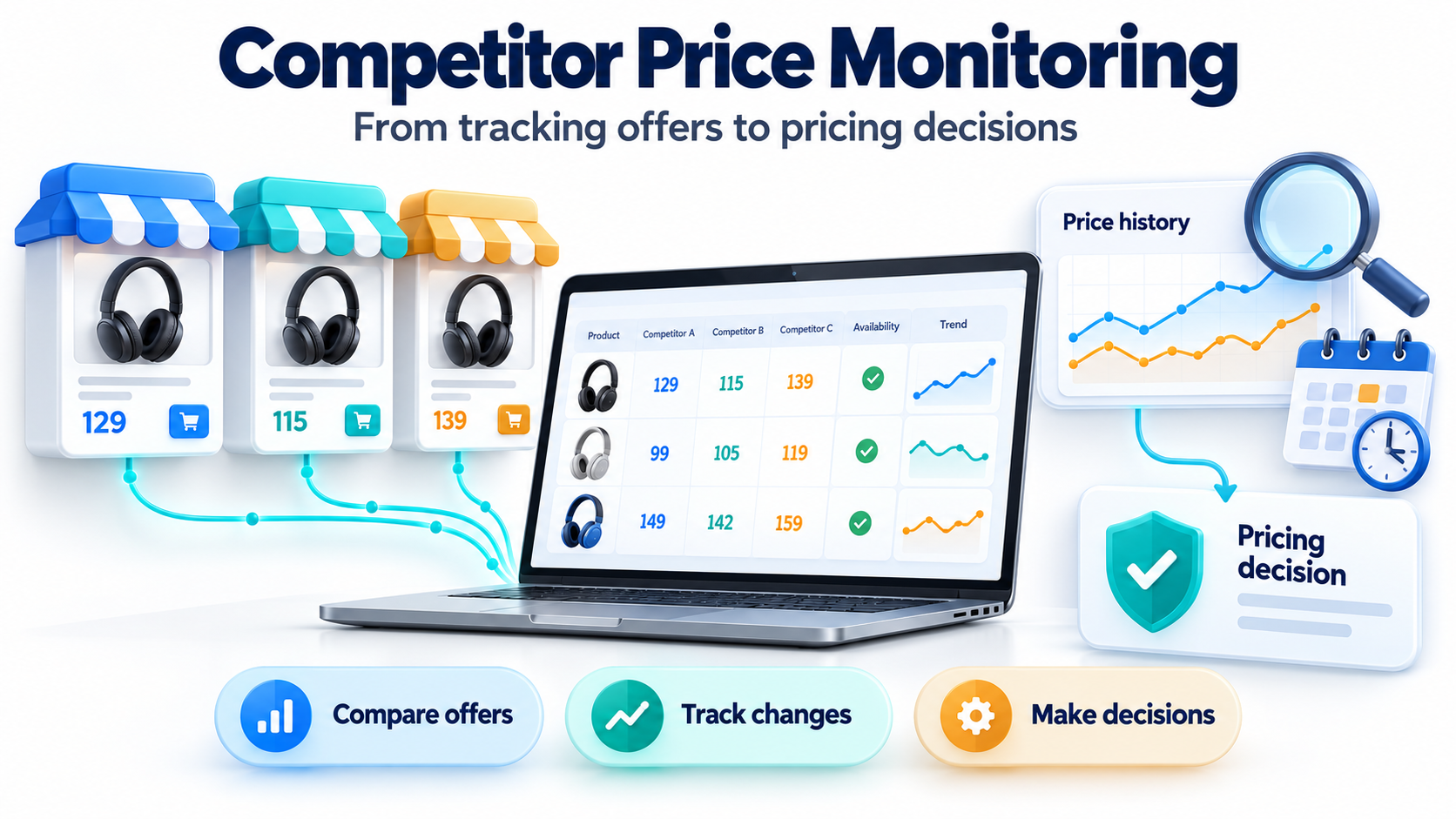
A competitor lowers a price. Should you match it, keep your current offer, or investigate first? The answer depends on more than the number displayed on a product page. Stock availability, delivery charges, promotional conditions, and your own costs can change the decision.
Competitor price monitoring is the regular collection and review of competing offers to support commercial decisions. Its value comes from comparing equivalent products, understanding changes over time, and deciding when action is justified.
Start with a business question
Before choosing software or uploading a catalogue, define what you want to learn. An online store might need to identify overpriced bestsellers, understand recurring promotions, or find products where a higher price could be tested.
Choose a small number of questions, such as:
Which important products are priced above comparable, available offers?
Where are we discounting without a clear competitive reason?
Which competitors regularly run promotions in our categories?
When does a price change deserve a review?
The eCommerce Fastlane article on why online stores use competitor price monitoring explores these practical uses. For your own project, connect each question to a person who can act on the findings.
Compare offers that customers can actually choose
A useful comparison starts with product matching. Similar names do not guarantee identical products. Check the model, configuration, pack size, condition, warranty, and included accessories.
Keep exact matches separate from substitutes. Both can inform decisions, but a lower price for an older model should not automatically trigger a reduction on a newer one.
For each competing offer, record:
Product identifier and source URL.
Seller and sales channel.
Current price and currency.
Availability.
Promotional conditions and delivery charges, where relevant.
Collection date and time.
A members-only discount or an unavailable product should remain visible as context, while being clearly distinguished from an offer that any customer can buy.
Separate data collection from monitoring
A scraper extracts information from a website. A monitoring process adds repeated collection, product matching, validation, historical records, and responsibility for reviewing results.
Our guide to price scraping and data validation covers the collection stage in more detail.
When choosing a tool, test it against your actual products and competitors. The Locator article on what to consider when choosing a competitor price monitor provides a useful starting checklist: accuracy, configuration, notifications, and integrations.
An overview of price monitoring services can help identify options for testing. Confirm current capabilities and terms directly, then evaluate the quality of the resulting data on a limited pilot.
Set a useful collection schedule
The right frequency depends on how quickly offers change and how quickly your team can respond.
A stable category may need fewer checks than a promotion-sensitive range. Important products can have a different schedule from the rest of the catalogue. Collecting data more often only helps when the extra observations support a decision.
The discussion of daily competitor price tracking explains why occasional checks can miss changes. Use that principle to choose a schedule suited to your market rather than applying the same interval everywhere.
Always display the latest successful collection time. A failed check should be marked as missing or stale data. It should not silently appear as a current price.
Read the history before reacting
A single observation shows an offer at one moment. Historical data helps reveal whether a change is temporary, repeated, or sustained.
Review the price alongside availability and promotional status. A short discount on a product that immediately sells out requires a different response from a persistent reduction across several important sellers.
Collection timestamps also have limits. If your system first observes a lower price at noon, that does not establish the exact moment the seller changed it. Similarly, successive reductions by several stores do not prove that one copied another.
Use history to identify patterns and questions worth investigating.
Turn observations into controlled decisions
A lower competing price can lead to several reasonable actions: maintain your price, review delivery terms, test a promotion, adjust advertising, or change the price within agreed limits.
Consider a hypothetical example. Your product sells for 100, while a competitor advertises 95. Before responding, you discover that the competing offer requires a paid membership and carries an additional delivery charge. The apparent five-point gap does not describe the full customer comparison.
If a price adjustment is justified, check purchase costs, fulfilment expenses, commissions, and the minimum acceptable margin. Assign responsibility for approving changes and recording the reason.
The eCommerce Fastlane article on competitor price monitoring and profitability discusses both competitive positioning and margin opportunities. Monitoring can also reveal where an unnecessarily low price deserves review.
Treat marketplaces as a separate comparison environment
On a marketplace, several sellers may offer the same product on one page. Track individual seller offers where possible, together with availability, delivery conditions, and promotions.
A changing minimum price can reflect a new seller, a temporary campaign, or an unavailable offer. It does not always indicate a broad market movement.
The overview of marketplace price monitoring connects offer tracking with seller decisions. Assess the results using your own sales and margin data: a lower price alone does not guarantee better visibility or more profitable orders.
Start with a pilot and review the outcome
Choose a manageable product group and the competitors most relevant to it. Check matching accuracy, data freshness, and the time required to investigate alerts.
Then review what the team actually did with the information. Did it identify useful pricing opportunities? Did it reduce manual checking? Were decisions supported by reliable comparisons?
Expand the project when the process works. A smaller, trusted dataset can support better decisions than a large catalogue full of uncertain matches.
Effective price monitoring connects reliable observations with a clear decision process. Collect comparable offers, preserve their context, review the history, and evaluate changes against your own commercial goals.
For guidance in other languages, read our Ukrainian guide to price monitoring or Russian guide to price monitoring.